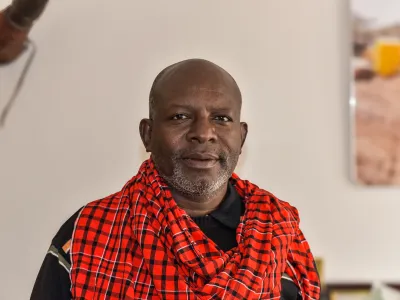
Malih Ole Kaunga
“Can the shift to clean energy be just, when it rises on the same lands once taken from Indigenous communities? What does inclusion in climate policy really mean, and who gets to decide? And how can decision-making power, and money, finally reach the people already sustaining these ecosystems?”
More about Malih Ole Kaunga
Malih Ole Kaunga is an Indigenous leader and long-standing advocate for the rights of pastoralist and forest-dwelling communities in Africa. His work connects land rights, human rights and climate justice as interdependent political and social questions.
Drawing on more than three decades of grassroots leadership, he works with nomadic pastoralists, forest communities and natural resource–dependent groups who are often excluded from dominant policy frameworks — despite their central role in stewarding land and ecosystems.
He is the founder of OSILIGI and a founder and advisor of IMPACT Kenya, a collective and organization working to build and strengthen inclusive, lifelong social movements. In this capacity, he has also been a key thought leader in the formation of several regional alliances, including the Pastoralists Alliance for Resilience and Adaptation Across Nations (PARAAN) and the Pan African Alliance for Indigenous Peoples and Local Communities.
During his fellowship at the Robert Bosch Academy, he examines how inclusive and intersectional climate justice movements can connect grassroots voices with regional and global decision-making spaces.
Can a just transition truly be inclusive, people-centered and purpose-driven?
What defines inclusion — and who decides?
Rather than approaching climate governance primarily as a technical policy field, he explores land as a site of rights, belonging and political agency. His fellowship also reflects on why Indigenous rights discourse continues to encounter resistance within governmental and multilateral structures, including the global climate conventions.
The fellowship offers space to deepen these reflections in dialogue with policymakers, philanthropists, academics and civil society actors in Berlin. At the same time, he brings extensive experience in community-based organizing and transnational advocacy into the Academy’s conversations.
For Malih Ole Kaunga, questions of land, justice and climate cannot be separated — they shape the conditions under which communities can sustain both their ecosystems and their political voice.
Resumé
2025 Speaks at the IUCN World Conservation Congress on Indigenous-led climate and biodiversity finance
2022 Coordinates Indigenous Peoples’ engagement at the African Protected Area Congress (IUCN)
2020 Founds the Kipok Fund for direct community financing
seit 2018 Founder and convener of the Pastoralists Alliance for Resilience and Adaptation in Northern Kenya Rangelands (PARAN); co-founder of the Maasai Cultural Heritage Centre; advisor to Nia Tero and Conservation International
2013 Launches the Camel Caravan along the Ewaso Ng’iro River, a cultural platform for peace and water
2010 Kenya’s new constitution recognizes historical land injustices, a clause his work helped drive
2004 Amid severe drought, communities occupy the contested ranches; the land claim fails and the protest is suppressed; he leaves the area for a time
2002–2004 Some 2,400 Maasai and Samburu are compensated; the case becomes a trigger point for strategic litigation across Kenya
2002 OSILIGI develops into IMPACT (Indigenous Movement for Peace Advancement and Conflict Transformation); he becomes Founder and Executive Director
2001 The claim is filed at the High Court in London (lawyer: Martyn Day)
1998 Launches the campaign against the British Ministry of Defence over unexploded ordnance on Maasai and Samburu land
1995 Founds OSILIGI (Organization for the Survival of Il-Laikipiak Maasai Indigenous Group Initiatives)
1995 Scholarship funded by the German government for training in rural development in Feldafing near Munich. Meets community empowerment organizers from Africa and Asia
1993 Degree in Water Resource Management, declines government employment with the Ministry of Water, and returns to the community
1984 His nine-year-old stepbrother is maimed by unexploded ordnance left by the British Army near the community’s only water source
1978-1989 Primary and Secondary School
1972 Born in Laikipia, northern Kenya, into a Laikipiak Maasai pastoralist family; largely raised by his paternal grandmother
Malih Ole Kaungas Richard von Weizsäcker Fellowship
Develop Themselves, Not Be Developed: Putting Communities at the Center of the Just Transition
As a Richard von Weizsäcker Fellow, Malih Ole Kaunga examines how inclusive and intersectional climate-justice movements can connect grassroots voices with the regional and global spaces where decisions are made. His starting point is uncomfortable. The shift from fossil fuels to renewable energy, he argues, too often repeats a colonial pattern: wind farms, geothermal plants and carbon projects rise on the same Indigenous lands, while communities are treated as beneficiaries rather than rights-holders, offered corporate social responsibility instead of a share of the profit.
What makes a transition truly just?
Rather than treating climate governance as a technical policy field, Ole Kaunga approaches land as a site of rights, belonging and political agency. He asks what inclusion really means, and who gets to define it. He also wants to understand why Indigenous rights claims keep meeting resistance inside governments, multilateral bodies and the global climate conventions. Crucially, he does not come only to criticize. He is developing a concrete mechanism to let climate and conservation resources flow directly to communities, so that the people already stewarding these ecosystems become shareholders in the transition, not obstacles to it.
Why Germany?
Berlin gives him a room he rarely reaches: policymakers, philanthropists, corporate climate initiatives and civil-society actors in one place. He is in conversation with German and European organizations working on carbon reduction and conservation, and wants to test his alternative against the institutions that fund and shape the energy transition. As one of the world’s largest donors and a strong voice in the EU and the climate conventions, Germany is, in his eyes, both part of the problem and a place where a better model could begin. He brings three decades of community organizing and transnational advocacy into that exchange, and intends to leave with allies, not just an audience.